
Skip to content
109 Progressive Ave. Roland, IA 50236 Quote Request

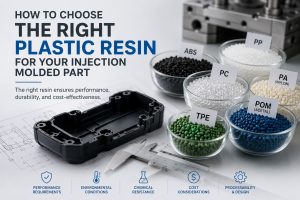
How to Choose the Right Plastic Resin for Your Injection Molded Part

How to Choose the Right Plastic Resin for Your Injection Molded Part

Few decisions shape an injection molded part more than the resin you choose. The right material meets your performance requirements, molds cleanly, and keeps unit cost in check. The wrong one can lead to warping, cracking, premature wear, or a part that simply costs more than it should. Yet plastic resin selection for injection molding is often rushed or copied from a previous project without much thought.

The good news is that choosing a resin follows a logical path. If you start with what the part actually has to do and work outward from there, the field of candidates narrows quickly. This guide walks through how to choose a plastic resin — the factors that matter most, a quick profile of common materials, and when to lean on your molder for help.

Start With Your Part’s Requirements, Not the Material

It is tempting to begin with a favorite material — “we always use ABS” — but that puts the cart before the horse. Effective thermoplastic resin selection starts with a clear picture of how the part will be used. What loads will it carry? What temperatures will it see? Will it be exposed to chemicals, sunlight, or moisture? Does it need to meet a regulatory standard like food contact or flammability?

Write these requirements down before you look at any material. When you define the operating environment and performance targets first, the resin choice becomes an engineering decision rather than a guess. It also gives you and your molder a shared checklist to evaluate candidates against.

Key Properties to Evaluate

Mechanical properties come first for most parts: tensile strength, stiffness, and impact resistance. A part that must absorb impact has very different needs than one that must stay rigid under load. Glass fillers can dramatically boost stiffness and strength when a base resin alone is not enough.

Thermal requirements are next. Every resin has a temperature range where it performs reliably; exceed it and the part softens, warps, or degrades. If your part sits near a motor, heating element, or in direct sun, thermal performance may drive the whole decision.

Chemical resistance matters wherever the part contacts oils, solvents, cleaning agents, or fuels. UV stability is critical for anything used outdoors, since unprotected plastics can chalk, fade, or become brittle. Finally, regulatory requirements — flammability ratings, food or medical contact, RoHS compliance — can eliminate otherwise suitable materials, so identify them early.

A Quick Guide to Common Resins

Polycarbonate (PC) is prized for exceptional impact strength and optical clarity, making it a go-to for lenses, guards, and rugged housings. It handles heat well but can be sensitive to certain chemicals. In a polycarbonate vs nylon comparison, PC wins on transparency and impact, while nylon wins on wear resistance and stiffness.

Nylon (PA 6 and PA 6/6) offers excellent strength, toughness, and abrasion resistance, and takes glass fill well for structural parts like gears, brackets, and load-bearing components. It does absorb moisture, which can affect dimensions, so that is a factor to plan around.

ABS is an easy-to-mold workhorse with good impact resistance and a nice cosmetic finish, common in enclosures and consumer products. Polypropylene (PP) is lightweight, chemical-resistant, and has a natural living-hinge capability. In an ABS vs polypropylene decision, ABS offers rigidity and finish quality, while PP offers chemical resistance and flex. PC/ABS blends split the difference, pairing ABS processability with added toughness and heat resistance. Rounding out the list, acetal (POM) delivers low friction and dimensional stability for precision parts, and polyethylene grades (HDPE, LDPE) provide low-cost, chemical-resistant options for less demanding applications.

Don’t Overlook Processability and Cost

A resin can look perfect on a datasheet and still be a poor fit if it is difficult to mold or expensive to run. Flow behavior, shrinkage, cycle time, and drying requirements all affect how consistently a part can be produced and what it costs per piece. Two resins that meet your mechanical targets can differ substantially in molded cost once processing is factored in.

It also pays to think about total cost, not just resin price per pound. A slightly pricier material that molds faster, scraps less, or eliminates a secondary operation can be cheaper in the finished part. Choosing a resin for injection molding is always a balance of performance, processability, and economics.

When to Ask Your Molder for Help

Material selection is one of those areas where experience saves real money. A molder who runs a given resin every day knows its quirks — how it shrinks, how it fills thin walls, where it tends to warp — in ways a datasheet cannot capture. Bringing your molder in early can prevent problems that would otherwise surface at the tooling or production stage.

At Hawkeye Molding, resin selection support is part of our product development services, and we process a broad range of materials in-house — polycarbonate, acrylic, nylon 6 and 6/6, glass-filled nylons, PC/ABS, ABS, ASA, HIPS, polypropylene, HDPE, LDPE, PET, acetal, and TPE. That range means we can help you compare realistic candidates rather than steering you toward whatever we happen to stock.

If you are early in a design and unsure which resin fits, we would welcome the conversation. Share your part requirements and our team can help you narrow the options and mold a material that performs the way you need it to.

Request a molding quote — https://HawkeyeMolding.com/molding-quote-request

Back To Top