
TPE Overmolding: What It Is, How It Works, and When to Use It Think of…
Plastic Injection Molding for Agricultural Equipment: Why Material and Durability Matter Most
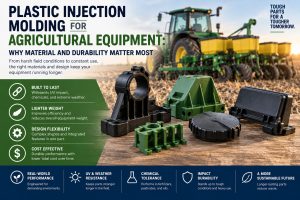
Plastic Injection Molding for Agricultural Equipment: Why Material and Durability Matter Most
Agricultural equipment does not operate in a controlled environment. It works in fields, feedlots, and farmyards — exposed to blazing summer sun, sub-zero winter temperatures, fertilizer overspray, hydraulic fluid, and the kind of mechanical abuse that would destroy components designed for gentler applications. When you are specifying injection molded plastic parts for ag equipment, the conversation has to start with durability. Getting the material wrong, or working with a molder who does not understand the ag environment, means warranty claims, field failures, and unhappy customers. Here is what engineers and buyers at agricultural equipment OEMs need to know.
Why Agricultural Applications Demand More From Plastic Parts
Agriculture is one of the most demanding environments any plastic part can inhabit. Unlike an office appliance or consumer product that spends its life indoors at room temperature, an ag equipment component might spend a decade cycling between -20°F winter storage and 130°F direct summer sun in a metal enclosure, while being periodically doused with anhydrous ammonia, diesel fuel, liquid fertilizer, or pesticide concentrate.
The mechanical loads in agricultural applications are also substantial. Vibration from diesel powertrains, impact from debris in harvesting environments, and the physical demands of operating large equipment in rough terrain put plastic components under continuous stress. A part that would last indefinitely in an appliance housing application might fatigue or crack within a single season in an ag equipment installation.
This means material selection and molder experience are not just important in agricultural injection molding — they are decisive. The right resin, processed correctly in a well-controlled mold, will survive for the expected service life of the machine. The wrong one will not, no matter how good the part geometry is.
The Harshest Conditions Plastic Has to Survive on a Farm
UV and weathering exposure is constant for any externally mounted component. Covers, guards, housings, and cab components on tractors, combines, planters, and sprayers face years of direct UV radiation. UV-induced degradation causes surface chalking, color fade, embrittlement, and eventually structural failure as the polymer chains break down.
Chemical resistance is equally critical. Agricultural chemicals — fertilizers, herbicides, insecticides, fungicides — are aggressive solvents and oxidizers that will attack certain polymer families. Hydraulic fluid, diesel, and lubricating oils are also present in abundance. A part that is chemically incompatible with its operating environment will swell, soften, crack, or disintegrate — often quickly.
Temperature cycling compounds both UV and chemical effects. The repeated expansion and contraction of thermal cycling creates fatigue stress in the polymer matrix, loosens mechanical connections, and accelerates degradation. Parts must maintain their mechanical properties across the full operating temperature range, not just at room temperature.
Impact resistance is the fourth dimension. Field equipment encounters rocks, debris, and accidental contact with tools and other equipment. Agricultural plastic components need to absorb impact without shattering — particularly in cold weather, when many polymers become brittle and lose impact resistance rapidly.
Materials That Hold Up in Agricultural Environments
Not all plastics are appropriate for agricultural applications. The resins that perform well in ag environments share a common set of characteristics: UV stability, broad chemical resistance, toughness across temperature extremes, and resistance to fatigue.
ASA (acrylonitrile styrene acrylate) is one of the top choices for exterior agricultural components. It offers excellent UV resistance, good impact performance, and an attractive surface finish that holds color well over years of outdoor exposure — all without requiring a secondary coating. ASA is a common choice for equipment covers, cab panels, and other visible exterior components.
Glass-filled nylons (Nylon 6 and Nylon 6/6 with glass reinforcement) deliver high strength, excellent heat resistance, and good chemical resistance, making them appropriate for structural brackets, housings, and mechanically loaded components where dimensional stability is critical. Glass filling increases stiffness and strength substantially compared to unfilled nylon.
HDPE (high-density polyethylene) and polypropylene offer excellent chemical resistance — HDPE in particular resists most agricultural chemicals effectively — along with good impact resistance at low cost. They are widely used for fluid handling components, guards, covers, and non-structural housings in ag applications.
As we covered in our guide to choosing the right plastic resin, the resin selection decision should always be made in the context of the specific application environment — not based on general-purpose defaults. A molder with deep material experience can help you evaluate resins against your specific chemical exposure, temperature range, and mechanical requirements.
Common Injection Molded Components in Ag Equipment
The range of injection molded parts in modern agricultural equipment is broad and growing. Increasing use of electronics, operator comfort features, and precision agriculture technology has expanded the plastic component content of tractors, combines, planters, sprayers, and application equipment significantly over the past two decades.
Cab and operator interface components include instrument panel surrounds, switch bezels, handle grips, and display mounts — parts that must provide a quality feel and dimensional stability in a thermally challenging cab environment. Exterior covers and guards protect mechanical systems, hydraulic components, and electrical enclosures from debris, weather, and physical damage. Fluid handling components including tanks, reservoirs, caps, and manifold housings must combine chemical resistance with structural performance. Cable management — routing clips, strain reliefs, and conduit fittings — keeps electrical harnesses organized and protected in a vibration and abrasion-rich environment. Seed and product metering components in precision planting and application equipment demand tight tolerances and consistent geometry to maintain application accuracy.
What to Look for in a Molder Who Understands Agriculture
The most important thing to look for in an ag equipment plastic supplier is genuine industry experience — not just a capability list. A molder who has produced components for agricultural applications understands the environmental context in ways that do not fit neatly into a spec sheet. They know which materials are problematic in certain chemical environments, how to design tooling that handles the fiber orientation challenges of glass-filled resins, and what field failures look like so they can be designed out of new parts.
Material capability breadth matters. Your ag equipment program likely spans multiple component types with different material requirements — ASA for exterior covers, glass-filled nylon for structural brackets, HDPE for fluid components. A molder who can process all of these in a single facility simplifies your supply chain and creates a single accountable partner for the program.
Quality systems and PPAP capability matter too, particularly as OEM customers in agriculture increasingly require documented qualification processes. ISO 9001:2015 certification establishes the quality management foundation; PPAP submission capability demonstrates that the molder can document process capability and dimensional conformance in the structured format that procurement organizations expect.
Agriculture is in our DNA at Hawkeye Molding. We are located in Roland, Iowa — the heart of the agricultural Midwest — and we have been producing plastic components for agricultural equipment OEMs for decades. Our 47-year track record, broad resin capability (including ASA, glass-filled nylons, HDPE, polypropylene, and more), and onsite tool shop make us a natural fit for ag equipment programs that demand durability and consistency. If you are sourcing injection molded plastic parts for agricultural applications, we would be glad to talk about your program at HawkeyeMolding.com/molding-quote-request.