
Plastic Injection Molding for Agricultural Equipment: Why Material and Durability Matter Most Agricultural equipment does…
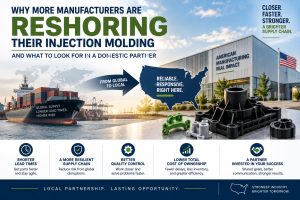
Why More Manufacturers Are Reshoring Their Injection Molding — And What to Look for in a Domestic Partner
Why More Manufacturers Are Reshoring Their Injection Molding — And What to Look for in a Domestic Partner
A few years ago, offshoring injection molding to low-cost regions seemed like a straightforward decision. The per-unit economics were hard to argue with. Today, the calculus looks different. A growing number of North American OEMs are actively bringing their plastic injection molding programs back to domestic suppliers — and the reasons go well beyond politics or sentiment. This post breaks down the real forces driving reshoring, the honest tradeoffs you should account for, and a practical framework for evaluating a domestic injection molding partner.
What’s Actually Driving the Reshoring Trend
The reshoring movement in injection molding is not driven by a single factor — it is the convergence of several pressures that, together, have shifted the math for many programs.
Supply chain disruption is at the top of the list. Container shortages, port delays, and long-haul logistics failures exposed a fundamental fragility in extended offshore supply chains. When your molder is twelve time zones away and a factory shutdown or shipping delay means six weeks of zero inventory, the cost of that risk becomes very real. As we explored in our post on why Iowa-made injection molding matters for your supply chain, geographic proximity creates resilience that is difficult to quantify until you need it.
Beyond supply chain risk, rising labor costs in traditional offshore manufacturing regions have narrowed the unit cost gap that made offshoring attractive in the first place. Add currency fluctuations, increasing regulatory complexity around import duties and tariffs, and the administrative overhead of managing overseas vendor relationships, and the offshore advantage shrinks further.
The Total Cost Picture: Why Per-Unit Price Isn’t the Whole Story
Let’s be direct: per-unit cost is often higher with domestic injection molding. Any reshoring analysis that ignores this is dishonest. But per-unit price is not the same as total landed cost — and total landed cost is what actually affects your margins.
Total landed cost for offshore molding includes ocean freight, customs duties, port handling, domestic drayage, expediting fees when deliveries are late, inventory carrying costs from safety stock required to buffer long lead times, travel costs for quality audits, and the engineering time spent managing supplier communication across language barriers and time zones. When you add these costs to the per-unit price, the offshore advantage often narrows significantly — and sometimes reverses entirely for lower-volume programs.
There is also the cost of quality escapes. A defective shipment discovered after a six-week ocean voyage is a very different problem from one discovered thirty miles from your facility. The cost of containment, rework, and production disruption from a quality event in an offshore program can dwarf the per-unit savings for that entire run.
Quality, IP, and Communication Advantages of Domestic Molding
Quality management is more tractable with a domestic partner. You can visit the facility without a twenty-hour flight, audit the process in person, and resolve issues in real time rather than through email chains that span business days. ISO 9001:2015 certification sets a defined quality management framework, but nothing replaces the ability to walk the floor, review PPAP documentation face-to-face, and have a direct conversation with the process engineer when something needs attention.
Intellectual property protection is a serious consideration for parts with proprietary geometry, embedded technology, or competitive differentiation. Domestic manufacturing keeps your IP within U.S. legal jurisdiction, with contracts that are enforceable in a familiar legal system. For many OEMs in industries like medical devices, defense, and agricultural equipment, this is a non-negotiable.
Communication — underrated and often decisive. Engineering changes, design iterations, scheduling adjustments, and quality discussions are dramatically easier when your molder is in the same time zone and speaks the same language. Misunderstandings in offshore molding programs frequently result in scrap, rework, and production delays that would have been avoided in a domestic relationship.
What to Look for in a Domestic Injection Molding Partner
Not all domestic molders are equal. When evaluating a U.S. injection molding partner for reshoring, focus on these factors:
Capacity and capability match: Does the molder have the tonnage range and machine count to support your program? Can they handle your part geometry, material requirements, and production volumes without being a marginal fit?
Quality system: ISO 9001:2015 certification is the baseline. Ask about PPAP capability, CMM and metrology equipment, and how they manage process control and corrective actions. A molder with a documented quality system is one you can audit and hold accountable.
Tool shop: An onsite tool shop means your molder can build, maintain, and modify tooling without subcontracting that work to a third party. This matters for lead times, cost control, and accountability when tool issues arise.
Material breadth: Your program’s material requirements may change. A molder with broad resin experience — across engineering polymers, commodity resins, filled materials, and specialty grades — can grow with your program without forcing a supplier change.
Track record: Years in business and customer retention signal operational stability. A molder who has been running programs for decades has seen problems you have not encountered yet and developed solutions for them.
Is Reshoring Right for Your Program?
Reshoring makes the most sense for programs where: total landed cost analysis shows the offshore savings are narrower than expected; supply chain reliability is a strategic priority; quality consistency is critical and hard to manage from a distance; IP protection is a concern; or lead time and communication responsiveness are competitive differentiators for your business.
It is less compelling for very high-volume commodity parts where the per-unit cost difference is large and quality requirements are relatively forgiving. Honest reshoring decisions are driven by the full program economics — not ideology or sentiment on either side.
Hawkeye Molding is an ISO 9001:2015 certified domestic injection molder based in Roland, Iowa, with 47 years of production experience, 25 injection molding machines across a 52,000 sq ft facility, and an onsite tool shop. We work with OEMs across agriculture, appliance, lighting, and industrial markets who are reshoring programs from offshore suppliers. If you are evaluating a domestic molding partner, we would welcome the conversation. Reach us at HawkeyeMolding.com/molding-quote-request.