
What Is PPAP and Why Does Your Injection Molder Need to Provide It? If you…
TPE Overmolding: What It Is, How It Works, and When to Use It
TPE Overmolding: What It Is, How It Works, and When to Use It
Think of a power tool with a soft, grippy handle molded onto a rigid body, a razor with a cushioned grip zone, or a sealed enclosure with an integrated gasket. Many of these parts are made with TPE overmolding — a process that combines a hard plastic base with a soft thermoplastic elastomer layer in a single finished component. It is a powerful technique, but one that designers often misunderstand or avoid because they are unsure when and how to use it.
The payoff for getting overmolding right is real: better grip, quieter and more comfortable products, built-in sealing, and a more premium feel — all without a separate assembly step. This guide explains what TPE overmolding is, how the process works, how it differs from two-shot molding, and the design rules that make it succeed.
What Is TPE Overmolding?
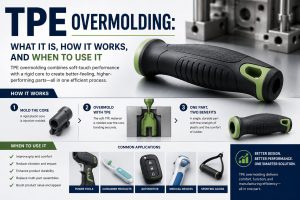
TPE overmolding is an injection molding process in which a soft thermoplastic elastomer (TPE) is molded over a previously molded rigid plastic part, called the substrate. The result is a single component with both hard and soft zones — for example, a firm structural body with a soft-touch grip. TPE is chosen for the soft layer because it flows and processes like a thermoplastic while behaving like rubber, offering flexibility, cushioning, and grip.
Because the soft and rigid materials bond during molding, there is no glue, no clips, and no separate gasket to install. The soft-touch overmolding zone becomes an integral part of the component. That integration is what makes overmolding so useful: functions that once required multiple parts and an assembly line are built directly into one molded piece.
How the Overmolding Process Works
The most common approach uses a two-step process. First, the rigid substrate is molded, either in a separate cycle or a separate machine. That substrate is then placed into a second mold, and the TPE is injected over it, flowing into and around the designed soft-touch areas. As the TPE cools, it bonds to the substrate, producing the finished two-material part.
Substrate placement can be manual or automated depending on volume and complexity, similar to insert molding. In fact, the thermoplastic elastomer overmolding process is closely related to insert molding — the key difference is that the “insert” being overmolded is itself a molded plastic part rather than a piece of metal hardware. Getting the process right depends on controlling temperatures and timing so the two materials bond reliably.
TPE Overmolding vs. Two-Shot Molding: What’s the Difference?
Two-shot molding (also called two-shot or 2K molding) achieves a similar hard/soft result but in a single specialized machine with two injection units and a rotating or shuttling tool. The substrate is molded, the tool indexes, and the second material is injected — all within one automated cycle, without removing the part between shots.
The practical difference comes down to volume and tooling. Two-shot molding offers very fast cycles and excellent repeatability for high-volume parts, but it requires specialized machines and more complex, expensive tooling. Overmolding as a two-step process is more flexible and cost-effective for low-to-moderate volumes and works with standard injection presses. When weighing overmolding vs. insert molding or two-shot, the deciding factors are usually volume, budget, and how tightly the two materials must be integrated.
Benefits of TPE Overmolding
The most visible benefit is improved grip and ergonomics. A soft TPE surface is easier and more comfortable to hold, especially in wet or high-use conditions. Overmolding also provides vibration damping, which reduces user fatigue and can quiet a product in operation.
Sealing is another major advantage: a TPE zone can serve as an integrated gasket, sealing out dust and moisture without a separate O-ring or assembly step. Aesthetically, overmolding enables two-color, two-texture parts and a premium soft-touch feel that differentiates a product on the shelf. And because these functions are molded in, overmolding often reduces total part count and assembly labor at the same time.
Design Rules and Substrate Compatibility
Success with overmolding starts with material compatibility. The TPE and the substrate resin must be chemically compatible to bond well; TPE grades are formulated to bond to specific base materials such as polypropylene, ABS, polycarbonate, or nylon, so the pairing has to be intentional. Where a strong chemical bond is not achievable, mechanical interlocks — grooves, undercuts, or holes the TPE flows into — can hold the layers together.
Geometry rules matter too. Consistent TPE wall thickness helps the soft material fill and bond evenly, transitions between hard and soft zones should be designed deliberately, and gate placement must push the TPE across the bonding surface. Planning these details early, with your molder, prevents delamination and short shots later. The TPE overmolding process rewards designs that are engineered for it from the start rather than adapted after the fact.
Applications Across Industries
Overmolded soft-touch grips and seals show up across the industries we serve. In appliances, TPE zones provide comfortable controls and dust or moisture seals. In agriculture and industrial equipment, overmolded handles and grips improve operator comfort and damp vibration on tools used all day. In furniture and consumer products, soft-touch surfaces add both function and a higher-quality feel.
At Hawkeye Molding, TPE over-molding is a standard capability, and we process TPE alongside a broad range of substrate resins in-house, from polypropylene and ABS to polycarbonate and nylon. That lets us help pair a compatible substrate and TPE grade and mold both under one roof, with the quality controls of an ISO 9001:2015 system behind every part.
If you are considering a soft-touch grip, an integrated seal, or any two-material part, we would be glad to talk through whether TPE overmolding is the right approach and how to design it for reliable bonding. Our team can help from concept through production.
Request a molding quote — https://HawkeyeMolding.com/molding-quote-request