
Why More Manufacturers Are Reshoring Their Injection Molding — And What to Look for in…
What Is PPAP and Why Does Your Injection Molder Need to Provide It?
What Is PPAP and Why Does Your Injection Molder Need to Provide It?
If you buy custom injection molded parts for appliance, automotive, or industrial products, you have probably seen PPAP listed as a supplier requirement. Many buyers know they need it without fully knowing what it covers or why it exists. That gap can lead to delays, incomplete submissions, and frustration on both sides when a program is trying to reach production.
PPAP for injection molding is not bureaucracy for its own sake. It is a structured way to prove that a molder can make your part correctly and consistently before the first production shipment leaves the dock. This post explains what PPAP is, what the five submission levels require, what a complete package looks like, and what to expect from a molder that does it well.
What PPAP Actually Is
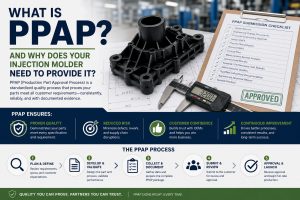
PPAP stands for the Production Part Approval Process. It is a standardized set of documents and sample parts that a supplier submits to demonstrate that its manufacturing process can reliably produce parts meeting all engineering and specification requirements. Originating in the automotive industry, PPAP has spread widely because it solves a universal problem: how does a customer gain confidence in a new part before betting production on it?
The core idea is simple. Rather than trusting that a first article looks right, PPAP requires the supplier to show that the actual production process — the same tooling, materials, and settings that will run day to day — produces conforming parts. The Production Part Approval Process turns “these samples look good” into documented, verifiable evidence.
The 5 Levels of PPAP Submission
PPAP defines five submission levels that determine how much documentation is sent to the customer versus retained at the supplier. Level 1 is a Part Submission Warrant (PSW) only, sent to the customer. Level 2 includes the PSW plus product samples and limited supporting data. Level 3, the most commonly required, includes the PSW, samples, and complete supporting documentation.
Level 4 covers the PSW and other requirements as specifically defined by the customer, giving flexibility for special situations. Level 5 includes the PSW, samples, and complete supporting data reviewed at the supplier’s manufacturing location, typically during an on-site audit. Understanding PPAP levels helps buyers request the right depth of documentation — Level 3 is the default for most new production parts, while lower levels may suit lower-risk changes.
What’s Included in a PPAP Package
A full PPAP package pulls together the evidence that a process is capable and controlled. Typical elements include the design records and engineering drawings, dimensional results showing measured parts against the print, and material and performance test results confirming the part meets specification. It also commonly includes a process flow diagram, a Process Failure Mode and Effects Analysis (PFMEA), and a control plan describing how quality is maintained in production.
Measurement System Analysis (MSA) studies, initial process capability studies (such as Cpk data), sample parts, and the signed Part Submission Warrant round out the package. Not every element is required at every level, but a thorough PPAP documentation set gives the customer a complete picture: what the part is, how it is made, how it is measured, and proof that the process holds tolerance.
Why PPAP Matters for Custom Injection Molded Parts
Injection molded parts are especially well suited to this kind of rigor because the process is repeatable and tool-driven. Once a mold and process are dialed in, the same part comes out cycle after cycle — but only if the process is truly capable. PPAP verifies that capability up front, so a program does not discover dimensional or material problems after thousands of parts have shipped.
For buyers in regulated or quality-sensitive markets, PPAP supplier requirements also protect the whole supply chain. A documented, approved process means changes are controlled, measurements are traceable, and the risk of a surprise nonconformance is sharply reduced. That is why so many OEMs make PPAP a gate that must be cleared before production is authorized.
What to Expect From Your Molder’s PPAP Process
A capable molder should treat PPAP as a normal part of launching a new part, not a scramble at the end. Expect clear communication about which submission level is required, realistic timing tied to tooling and sampling, and a package that is complete and accurate the first time. A good molder will also flag specification questions early, before they become submission problems.
At Hawkeye Molding, PPAP and capability studies are part of our quality services, backed by an ISO 9001:2015 quality system (Certificate #US2714) and in-house metrology including CMM measurement. That means the measurement, documentation, and process discipline needed for a clean PPAP submission are built into how we run programs — not bolted on at the end.
If you need a molder who can deliver complete, on-time PPAP documentation for a new or transferred part, we are ready to help. Our quality team can walk you through the submission level your program requires and what to expect at each step.
Request a molding quote — https://HawkeyeMolding.com/molding-quote-request