
TPE Overmolding: What It Is, How It Works, and When to Use It Think of…
Steel to Plastic Conversion: When It Makes Sense — And When It Doesn’t
Steel to Plastic Conversion: When It Makes Sense — And When It Doesn’t
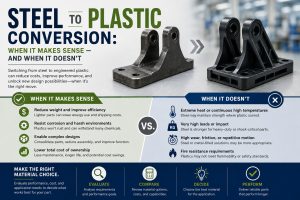
More manufacturers than ever are looking at their metal components and asking a simple question: does this really need to be metal? Steel to plastic conversion — replacing a metal part with an engineered thermoplastic version — can reduce weight, lower cost, and simplify assembly. Done well, it is one of the most effective cost-reduction moves available to a product team.
But conversion is not a universal win. Some parts are excellent candidates and some absolutely are not, and treating every metal part as a conversion opportunity is a good way to end up with a plastic part that fails in the field. This post takes an honest look at when steel to plastic conversion makes sense, when it does not, and how to tell the difference.
Why Manufacturers Are Rethinking Metal Parts
Several pressures are pushing metal to plastic conversion up the priority list. Material and machining costs for metal parts have climbed, supply chains have proven fragile, and demand for lighter products keeps rising across appliance, agriculture, industrial, and consumer markets. Engineered plastics have also improved dramatically, with glass-filled and specialty grades now capable of carrying loads that once required metal.
At the same time, injection molding offers something metal fabrication struggles to match: the ability to consolidate several machined or stamped pieces into a single molded part. When a bracket, its fasteners, and a few clips all collapse into one molded component, the savings show up in both material and assembly labor.
The Real Advantages of Converting to Plastic
Weight reduction is usually the headline benefit. Plastic parts can weigh a fraction of their metal counterparts, which matters for anything shipped, carried, or moved repeatedly, and for products where efficiency or ergonomics are selling points. Weight reduction with plastic parts often ripples outward — lighter assemblies can mean smaller motors, easier handling, and lower freight.
Cost is the other big driver. Beyond raw material savings, molding replaces multi-step metal processes — cutting, machining, welding, finishing — with a single automated cycle. Plastics also resist corrosion without plating or paint, can be molded in color to skip finishing entirely, and enable complex geometries that would be costly to machine. For the right part, steel replacement with plastic reduces piece cost, tooling maintenance, and secondary operations all at once.
Parts That Are Good Candidates (And Parts That Aren’t)
Good candidates tend to be parts where metal is overkill for the actual loads, where corrosion or weight is a problem, or where several metal pieces could be consolidated. Housings, covers, brackets, handles, knobs, guards, and moderately loaded structural components frequently convert well. Parts currently made from stamped or machined metal for convenience rather than necessity are prime targets.
Poor candidates are parts that see extreme loads, high sustained temperatures, or heavy wear that even filled plastics cannot handle, as well as parts that must conduct significant electricity or heat. Very large parts, components with tight metal-level tolerances across big spans, or safety-critical elements with narrow margins may also be better left in metal. The honest answer is that converting the wrong part costs more than it saves — so candidate screening matters as much as the conversion itself.
Engineering Considerations Before You Convert
You cannot simply mold a plastic copy of a metal part; the geometry usually needs rethinking. Plastics behave differently under load, so ribs, gussets, and wall-thickness changes are used to build in stiffness rather than relying on solid mass. Uniform wall thickness is important to avoid sink and warp, and sharp internal corners are replaced with radii to reduce stress concentrations.
Material selection is central. A part that carried structural load in steel may need a glass-filled nylon or another engineering resin, chosen against the real thermal, chemical, and mechanical requirements. Differences in thermal expansion, creep under sustained load, and fastening methods (molded-in threads or inserts versus tapped metal) all have to be accounted for in the redesign. This is where converting metal parts to plastic becomes an engineering exercise, not just a material swap.
How the Conversion Process Works
A sound conversion starts with reviewing the existing part, its function, and its true performance requirements — not just copying its dimensions. From there, engineers redesign the geometry for molding, select a suitable resin, and often build a prototype or run analysis to validate performance before committing to production tooling. Tooling is then designed and built, samples are produced and measured, and the part is qualified before full production.
At Hawkeye Molding, steel-to-plastic conversion is part of our product development services, supported by an onsite full-service tool shop and metrology capabilities including CMM measurement. That combination lets us take a metal part from evaluation through redesign, tooling, and validated production under one roof, with the quality documentation to back it up.
If you have a metal part you suspect could be lighter and less expensive as plastic, we are glad to give you a candid assessment — including telling you when conversion is not the right move. Our engineering team can review the part and outline a realistic path.
Request a molding quote — https://HawkeyeMolding.com/molding-quote-request