
Skip to content
109 Progressive Ave. Roland, IA 50236 Quote Request

What Is Insert Molding — And When Should You Use It?

What Is Insert Molding — And When Should You Use It?

If you are designing a plastic part that needs to attach to metal, carry threaded fasteners, or combine two materials into one finished component, you have probably run into a decision point: mold the insert directly into the part, or add it later in assembly. Insert molding is the technique that answers that question, and for the right application it can eliminate assembly steps, strengthen the finished part, and cut long-term cost.

Still, insert molding is not automatically the best choice for every project. Understanding how it works, where it shines, and where post-molding assembly makes more sense will help you specify the right process from the start — and avoid expensive redesigns later. Here is a plain-language guide to what insert molding is and when to use it.

How Insert Molding Works

Insert molding is an injection molding process in which a pre-formed component — most often a metal part such as a threaded bushing, pin, contact, or stud — is placed into the mold cavity before plastic is injected. When molten resin flows in, it surrounds and locks onto the insert. Once the part cools and ejects, the insert is permanently encapsulated in the finished plastic component.

The insert can be loaded into the tool manually by an operator or placed automatically, depending on volume and part complexity. Precise placement matters: the insert has to be held securely so it does not shift when high-pressure resin enters the cavity. Because the plastic bonds around the insert as it solidifies, the mechanical connection is far stronger than simply pressing or gluing a part in afterward.

The insert molding process is a single-step operation. Instead of molding a part, then drilling, tapping, or pressing in hardware as a separate line, you get a finished assembly straight out of the press. That consolidation is where much of the value comes from.

Insert Molding vs. Post-Molding Assembly: What’s the Difference?

The main alternative to insert molding is post-molding assembly, where the plastic part is molded first and the insert is added later — for example, by heat-staking or ultrasonically installing a threaded insert into a molded boss. Both approaches produce a plastic part with embedded hardware, but the tradeoffs are different.

Insert molding removes secondary operations and typically produces the strongest bond, since the resin flows fully around the insert. It works well for higher volumes where the cost of loading inserts is offset by eliminating downstream labor. Post-molding assembly, on the other hand, offers more flexibility: it keeps the molding cycle simpler and lets you install inserts only on the parts that need them, which can be a better fit for lower volumes or designs still in flux.

People sometimes confuse insert molding with overmolding. The distinction is straightforward. In insert molding, plastic is molded around a solid, usually non-plastic insert. In overmolding, a second layer of plastic (often a soft thermoplastic elastomer) is molded over an existing plastic substrate. Insert molding vs. overmolding really comes down to what is being encapsulated — hardware versus a softer plastic layer.

Common Applications for Insert Molding

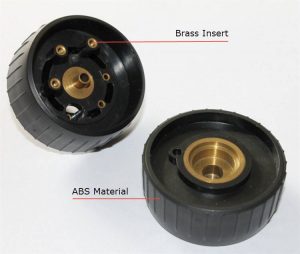
Threaded insert molding is one of the most common uses. Molding a brass or steel threaded insert directly into a plastic housing gives you durable, reusable screw threads that hold up to repeated assembly and disassembly far better than threads cut into plastic alone. This is widely used in appliance, electronics, and industrial enclosures.

Metal insert molding also appears in electrical components — pins, terminals, and contacts encapsulated in plastic connectors — as well as in knobs with metal shafts, handles with reinforcing rods, and structural parts that need a metal load path inside a plastic body. Anywhere a design combines the strength or conductivity of metal with the light weight and design freedom of plastic, insert molding is worth evaluating.

Materials and Inserts That Work Best

Inserts are commonly brass, stainless steel, or plated carbon steel, chosen for strength, corrosion resistance, and thermal behavior. Because the insert sits in the mold as hot resin flows around it, the insert needs to tolerate molding temperatures and, ideally, feature knurling, grooves, or undercuts that let the plastic grip it mechanically.

On the resin side, engineering thermoplastics that flow well and bond reliably around inserts are typical choices — nylon 6 and nylon 6/6, glass-filled nylons for added stiffness, polycarbonate and PC/ABS blends, and ABS. Matching the resin to the insert (and to the thermal expansion differences between metal and plastic) is an important detail; a mismatch can create stress around the insert over time.

Is Insert Molding Right for Your Project?

Insert molding tends to make sense when a part needs strong, permanent metal-to-plastic connections, when you want to eliminate secondary assembly, and when volumes justify the added handling in the press. If your design is still changing, your volumes are low, or only a fraction of parts need hardware, post-molding assembly may be the more economical path.

The best time to make this call is early in design. Deciding on insert molding up front lets you engineer the boss geometry, insert retention features, and tooling correctly rather than retrofitting later. At Hawkeye Molding, insert molding is a standard capability supported by a fleet of 25 horizontal injection molding machines and an ISO 9001:2015 quality system, so parts are produced consistently and documented to spec. Our team can also help evaluate whether insert molding or post-molding assembly is the better fit for a given part.

If you are weighing insert molding for a new part or trying to reduce assembly steps on an existing one, we are happy to review your design and talk through the options. Our engineering and tooling teams work with a wide range of resins and insert types every day.

Request a molding quote — https://HawkeyeMolding.com/molding-quote-request

Back To Top